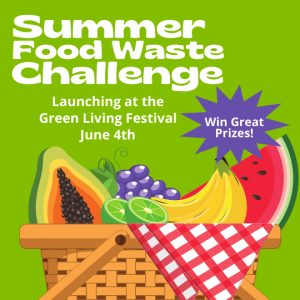
Click the image to view and download the Challenge.

Summer Food Waste Challenge

The Summer Food Waste Challenge has officially ended, but you can still challenge yourself to reduce your food waste!  Feel free to download it!

Why care about food waste? Did you know that we each throw away approximately $1300 worth of good food each year? That can be up to 40% of the food that comes into our homes! And reducing our food waste is one of the best ways each of us can fight climate change.

We’ve created a fun way for you to learn more about food waste and challenge yourself to do more to reduce your food waste. Download the Summer Food Waste Challenge to get started!  Complete 6 of the Challenges and turn in your sheet sheet by August 15th to any of these locations: earthday365’s Tower Grove Farmers’ Market Booth, the St. Louis Science Center GROW Pavilion, Local Harvest Grocery, City Greens Market, or by email to info@earthday-365.org!

You’ll be entered to win 1 of many prizes including tickets to the St. Louis Science Center OMNIMAX Theater and Missouri Botanical Garden.

Grant funded by:

Americans waste
roughly 40%
of their food.

Wasting food
feeds the
Climate Crisis
Why
should I care
about
food waste?
What
can I do
about
this problem?
arrow_downward

Uneaten food causes unneeded strain on the environment by wasting valuable resources like water and farmland. Food production is a resource-intensive process, requiring water, energy, land, soil, human labor and an elaborate web of production, processing and distribution infrastructure. When we throw away food, all these resources are squandered: in the US, food waste consumes 21 percent of our freshwater, 19 percent of our fertilizer, 18 percent of our cropland and 21 percent of our landfill volume. At a time when 12 percent of American households are food insecure, reducing food waste by just 15 percent could provide enough sustenance to feed more than 25 million people, annually. Of the estimated 125 to 160 billion pounds of food that goes to waste every year, much of it is perfectly edible and nutritious. Most importantly, it’s one of the biggest ways individuals can impact climate change through their personal actions — while saving money! Overbuying, poor planning and confusion over labels and safety contribute to food waste at stores and in homes. Food waste also has a staggering price tag, costing this country approximately $218 billion per year — or $1300 – $2275 per household.

We can end food waste. Our main goal is to keep food from being thrown into the landfill by following the REDUCE, REUSE, RECYCLE strategy. First, we want to reduce the volume of surplus food generated. Then, reuse edible food and scraps to support food getting eaten by people and animals or used in industry. Learn to cook with food scraps

Play Video

Ways to help Learn what "best by/sell by/use by" dates actually mean. Make grocery lists and stick to them. Composting food is the last chance before sending it to a landfill. Plan meals ahead of time. Learn about Composting Options Plan meals around food that's about to expire. Eat leftovers.

Find a
local
composter
Recipes -
more flavor,
less waste
Do a Home
Food Waste
Audit

As seen in
Sauce Magazine
Grant funded by:
MO DNR logo SWMD logo
0